Monday, 10 June 2013

28mm Napoleonic game

John working out his battle plan
 John brought his Napoleonic collection round last weekend and we had another game using General de Brigade rules. We only had four hours to get the game in so I thought it may be fun and save a little time if we did a hidden deployment using spare terrain tiles. 
The scenario
The British were to take a village covering an important road, whilst the French were to hold it.

initial deployment
 With this in mind we set to deploying our troops. I concentrated most of my (British) strength on my centre and left, expecting tough resistance in all the hedgerows and withing the buildings. On my right I deployed my cavalry in the open ground with orders to support the attack. 
French left
 So imagine my surprise when the blinds were removed and most of the French was on my right flank and centre. John had just left one battalion in the buildings and another in the hedgerows.
Also there was another battalion deployed a little to close to my artillery (within canister range!!!) this was a slight anomaly from the use of hidden deployment.

guns sighting on the French held village

Rockets!

French cavalry

the cavalry battle
 The game opened with John using a tactical move to bring his Polish brigade into the centre whilst his cavalry came on a little to rapidly for my liking. I moved up my left brigade to start clearing the hedgerows whilst my 2nd brigade rapidly advanced towards the village, whilst rockets screamed over head crashing into a Veteran French battalion faltering it. 
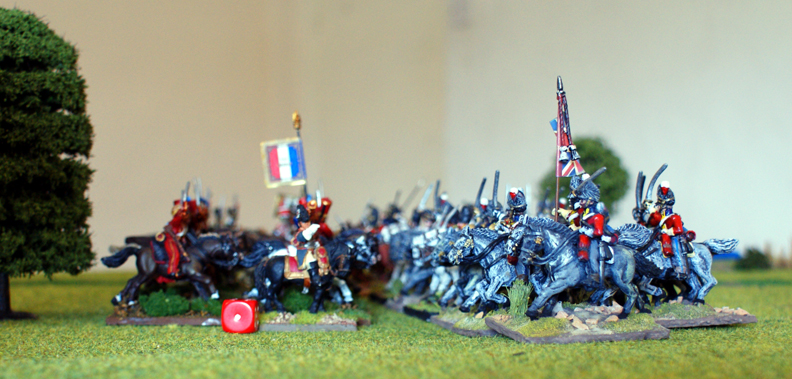
 The next turn and John won the initiative (which he always seems to do ;0). He charged his 2 regiments of light cavalry into my heavy cavalry which managed to counter charge.
The end result was a win each. The chaussers soundly beating my dragoon guards and The Scots greys crushing the Hussars. The Scots greys then continued to pursue in an uncontrolled manner. which was a shame as a slight wheel to the left and i would of caught the Polish in line out in the open.
British line supporting the attack

the French centre

the British advance
the highlanders charge towards the village, bagpipes blaring
 As the action became more intense I seem to of forgotten to use the camera.
 So there are no pictures as proof of the brave highland charge that routed the French from the village, at the same time the 22nd and 27th regiments of foot cleared the hedgerows on the right of the village of any resistance.
 in the meantime the armies joined in the centre with the Poles being seen off by a devastating volley from the 66th.
With this a general retreat was made leaving the field to the British.
polish being seen off by an effective volley

A great game was had, lasting around 3 hours with some furious action. We learned a few lessons regarding the rules. One, large battalions firing at effective range are pretty awesome! two, rolling double one with your artillery on the first turn is a real downer. We both did this, john with his 12lbs supporting the village and me with my most important battery on the hill over looking the village.

   we also couldn't find how we go about the cavalry pursuit in the following turn. It wasn't until the evening as i was having a cool beer on the patio that I found it in the rule book right where i'd loooked around a dozen times that afternoon. You do another pursuit test.....    logical really.

Sunday, 12 May 2013

The Battle of Magnesia 190BC pt2

The Romans wished to fight this battle, before a new consul was sent out from Rome and winter would lead the campaign to a halt. Scipio had successfully crossed the river and set up a camp only about 3 miles from the camp of Antiochus. Scipio's further advance from his camp was made with the river protecting his left, where he would rest his arrayed legions. Except for 4 squadrons all the allied cavalry was on its right when the battle started.
As in almost all ancient battles, different reconstructions are possible. Appian has the battle start on the Seleucid left with a failed attack by the scythed chariots which disrupted the Seleucid cavalry on the left wing. At the same time, there was a charge on the right by the Seleucid cavalry wing commanded by the king himself, which broke their opposing infantry leading to a pursuit, where the Seleucid horse left the field to unsuccessfully attack the Roman camp.
   The Roman ally Eumenes, commanding all their cavalry on the right of the Roman-Allied army counterattacked the Seleucid left, which was already disrupted by the scythed chariots, and broke it. In the center of the battle line, the Seleucids had arrayed their pike phalanx with elephants in intervals between the taxeis. They seem to have been unable to really participate in the battle, having soon been encircled by the victorious enemy horsemen. Forming squares facing all sides, the pikemen tried to march off the battlefield but they broke when the elephants panicked. Eventually, after further fighting, the Seleucid camp fell.


After an armistice was arranged between Antiochus and Rome, the Roman army waged a campaign against the Galatians which politically undermined the Seleucid position in Asia Minor. The Romans had had a tremendous advantage throughout their campaign from their much more limited political objective. All the small powers could ally themselves to Rome because Rome sought no political annexations at this time. Conversely, Antiochus desired to conquer Asia Minor, as he saw himself in the vein of Alexander the Great. The Aegean Sea was a natural frontier for a state based in Babylonia, as Xerxes discovered long ago. If Antiochus had wanted to advance west into Greece, he needed to turn his state into the leading naval power in the Mediterranean, from nowhere, before sending his army west.

The treaty forced upon Antiochus III by the victorious Romans was crippling, in the Treaty of Apamea Antiochus was forced to pay a huge war indemnity of 15,000 Talents along with giving up significant territory in Asia Minor. The Taurus Mountains became the new frontier. The Seleucid navy was limited by treaty, and their squadrons of war elephants destroyed. It weakened the already fractious Seleucid Empire and halted all ambitions of Antiochus III in becoming a latter day Alexander in his own right.

 Polybius states the financial burden of war indemnity forced Antiochus III to loot temple treasuries. This alienated Seleucid subjects and further reduced the dynasty's prestige already sharply reduced by the decisive defeat suffered against the Romans.


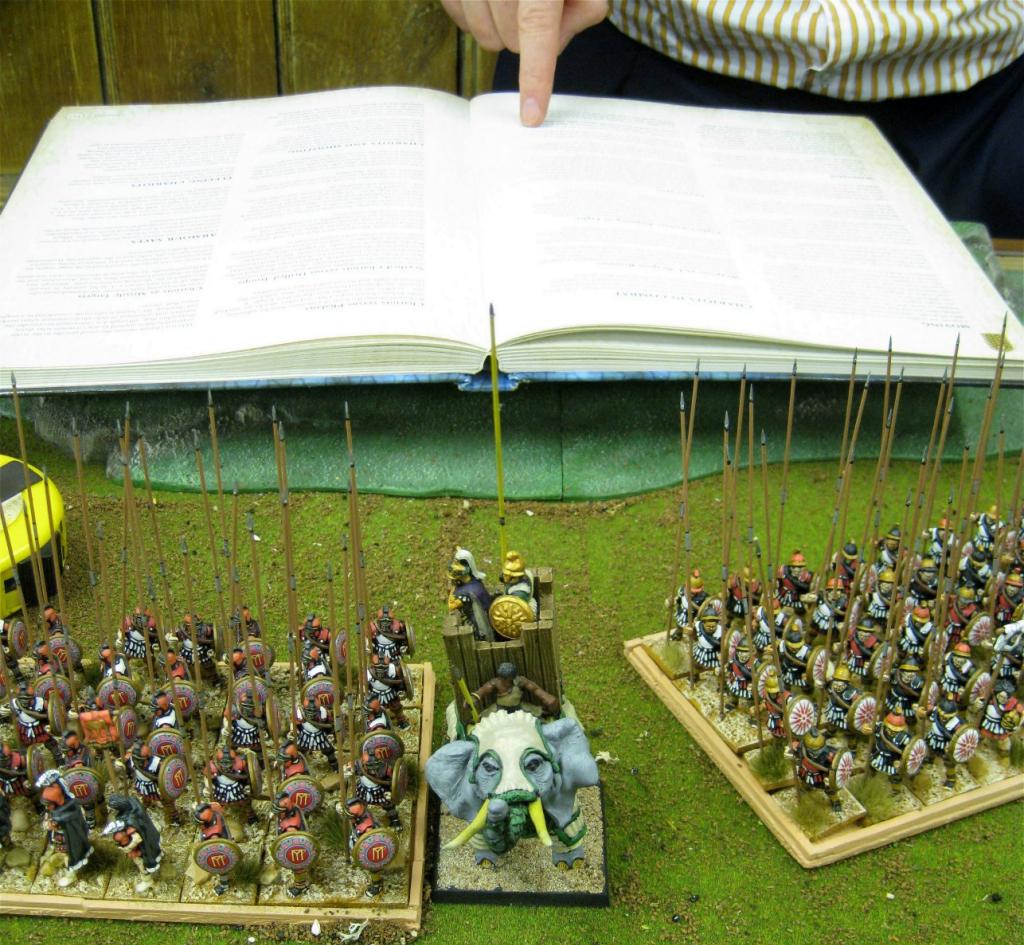
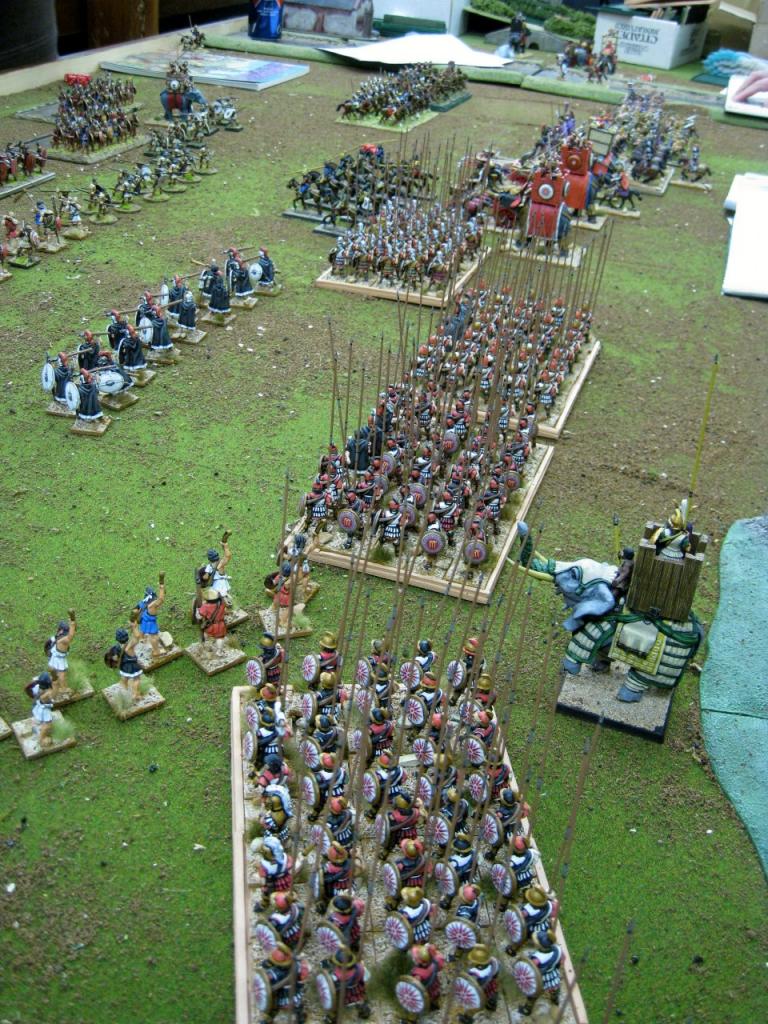
 The game was fought using Warhammer ancient battles, yes we still play it long after its death...
at present the game is in the balance and all is to play for.
you need 2s to wound...


Friday, 10 May 2013

the battle of Magnesia 190BC

 The Battle of Magnesia was fought in 190 BC, on the plains of Lydia (modern Turkey), between  Romans, led by the consul Lucius Cornelius Scipio and his brother, Scipio Africanus, with their ally Eumenes II of Pergamum against the army of Antiochus III the Great, Emperor of the Seleucids.


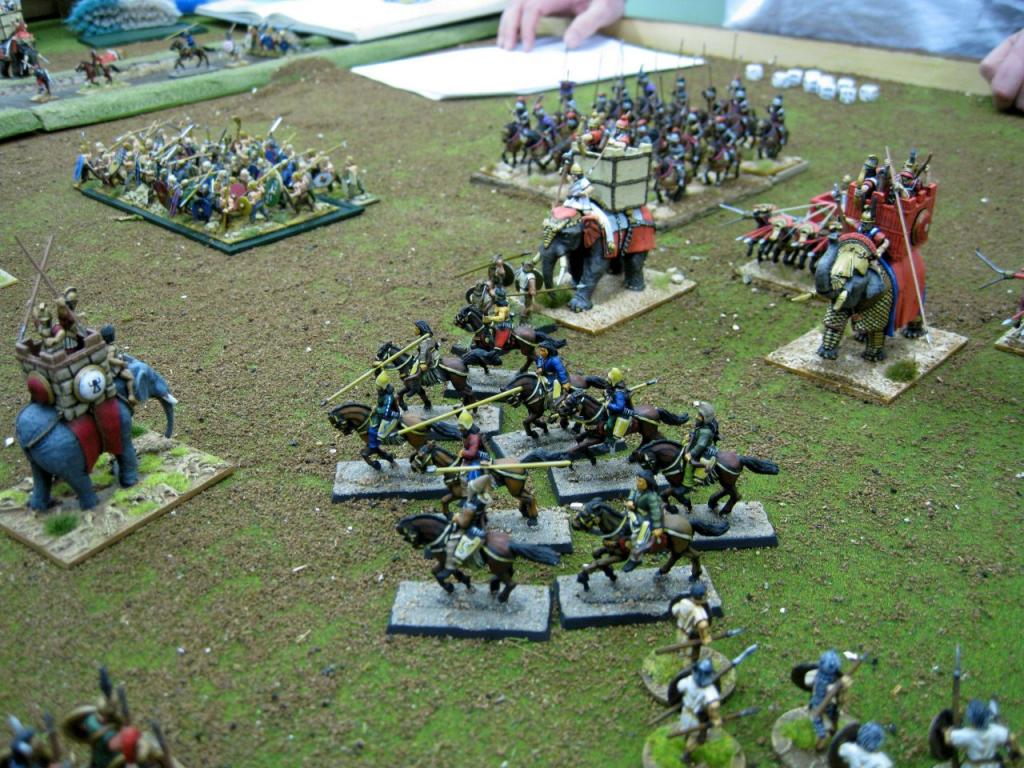
 The armies deploy for battle.


Antiochus was driven out of Greece following the defeat of his army at the Battle of Thermopylae (191 BC). The Roman navy and her allies outmaneuvered and defeated the Seleucid navy, permitting the Roman army to cross the Hellespont. The Roman army operated under the commands of the consul Lucius Cornelius Scipio, brother of Scipio Africanus. Africanus  accompanied him as legatus. The Carthaginian general and dire enemy of the Roman Republic Hannibal Barca, had fled to Antiochus' court after his defeat at the Battle of Zama and the end of the Second Punic War.
  Some believe that Hannibal was present at Magnesia. But sadly for Antiochus this is false as Hannibal, who had commanded the fleet and lost at Eurymedon, had retreated and then fled to Crete for fear that Antiochus would lose and turn him over to the Romans.


Last Tuesday I was merrily making my way down the A14 with lots of time to spare on my journey to Daves for the game, when some dork driving a lorry decided to change lane with out thinking or looking, this made me have to evade into the next lane and quickly jink back in before hitting another car. I thought nothing of it apart from the usual "lorry drivers are twats".
5 minutes later i felt as if i had a puncture so i pulled over but everything seemed ok. so i carried on my journey only to feel the same odd feeling form the back of the car.
to cut a long boring story short my rear wheel bearing had collapsed and the wheel was being held on by just the brake caliper.
So instead of being a part of the wonderful game you can see above and below i was on the back of the tow truck and eventually heading home.
As you can see scythed wheels had been added for the occasion.


In anticipation of the battle, Antiochus set up an entrenched camp protecting the approach to Sardis and his fleet base at Ephesus. According to both Livy and Appian, he posted his 16,000 strong phalanx, armed in the Macedonian fashion in the center in brigades (taxeis) of 1,600 men, 50 men wide and 32 men deep. He ordered intervals to be formed among the taxeis in which he placed 2 elephants each. On the right wing, next to the phalanx, he arrayed 1,500 Gallograecian infantry, 3,000 Galatian mail clad cavalry (cataphracti) and 1,000 agema cavalry, his royal household guards. Behind them he kept 16 elephants in reserve. Next to the agema, he placed a cavalry corps Livy calls argyraspides, 200 or 1,200 Dahae horse archers, 3,000 Cretan and light infantry, 2,500 bowmen, slingers and archers. On the left, Antiochus arrayed another 1,500 Gallograecian infantry, 2,000 Cappadocians. Next to them, he posted 1,000 heavy horsemen, the Companions, 3,000 more cataphracti and probably another 1,000 men of the agema. In front of them, he placed the scythed chariots and a unit of dromedary, camel-borne Arab archers. His left wing was completed with a corps of Tarentines, 2,500 Gallograecian cavalry, 1,000 newly enlisted Cretans. Then came 4,000 peltasts. Finally sixteen elephants.
    Antiochus retained command of the horse on the right wing in person; his son Seleucus and his nephew Antipater commanded the left. Philip, the master of the elephants, commanded the phalanx, and Mendis and Zeuxis the skirmishers.


The Romans arrayed in their customary triple line formation with their left wing resting on the river. The Roman reinforced legions occupied the center of this formation and the Latins, the Ally legions, on their wings. In all, there were 20,000 men of the legion. Behind them, Scipio held his 16 elephants in reserve, fully aware that the African elephants could not face the larger Indian elephant on equal terms. On the right Scipio placed the allied Pergamene army under Eumenes and the Achaean peltasts, 3,000 in all to cover the flank of the legions. Next to them he placed his cavalry, nearly 3,000 strong, 800 of them Pergamenes, the rest legionary cavalry. In the extreme right he posted the 500 Cretan light troops and archer.
Domitius was stationed with 4 squadrons of cavalry on the right wing, Scipio kept command of the center and gave command of the left to Eumenes.
In all, both writers agree that the Roman army was about 30,000 strong and the Seleucids about 70,000. However, historian Grainger argues that the two armies might have been not that numerically different and supports that the Romans fielded about 50,000 men as did Antiochus.
A popular anecdote regarding the array of the two armies is that Antiochus supposedly asked Hannibal whether his vast and well-armed formation would be enough for the Roman Republic, to which Hannibal tartly replied,
 "quite enough for the Romans, however greedy they are."
 

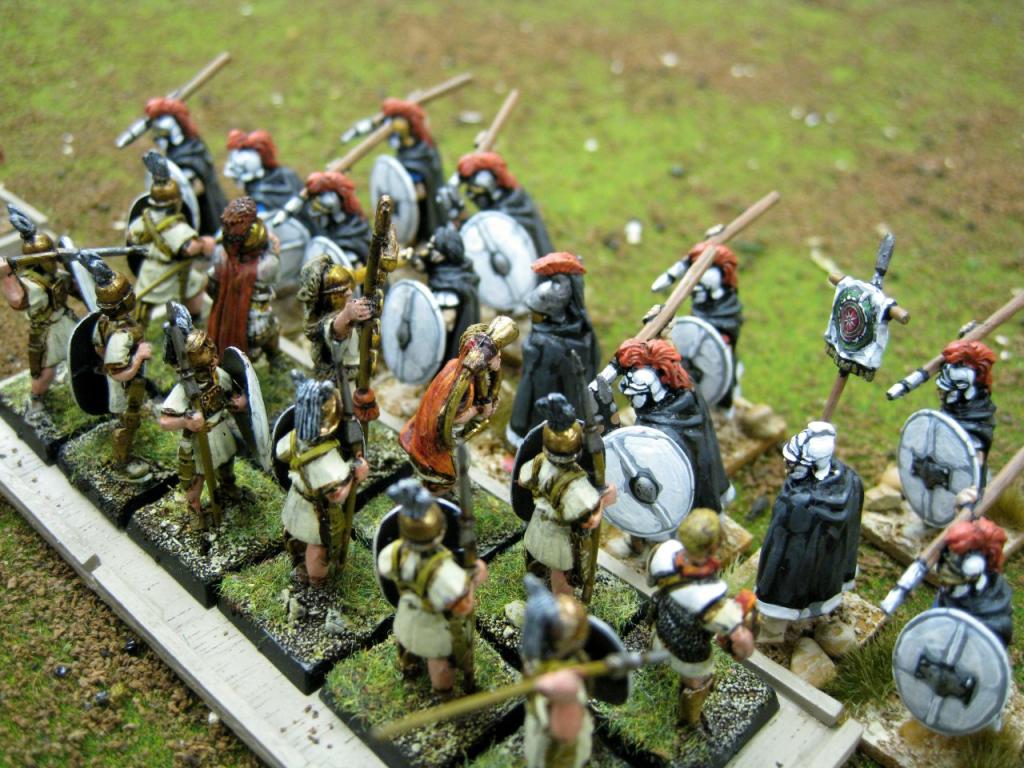
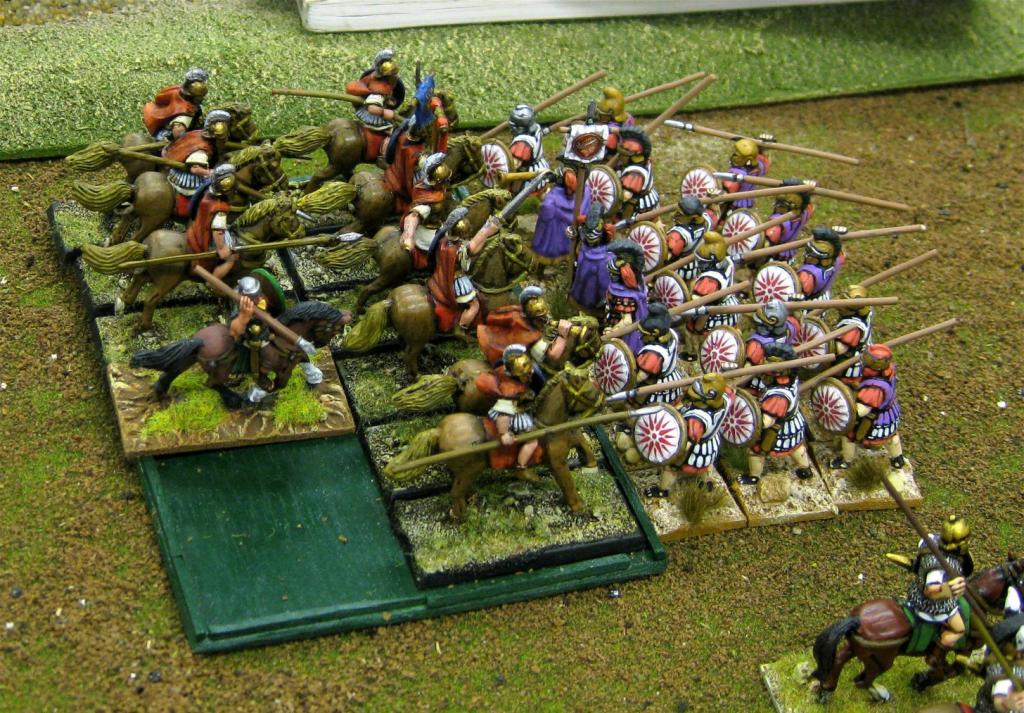
So what should of been a battle report post is now a photo shoot, but i must say the game looks great!
all pics are by Joe "Lone wolf" Dever, cheers Joe!
figures painted by lots of different people including a fair amount by me see if you can spot them for a prize? :0)
more pics to follow tomorrow